January Is the Worst Month on a System You Don't Really Trust
Why January tests every assumption your system makes about your clients, and what it looks like when the system does the checking.

It's the first Monday in January. Half the clients on today's schedule had their plans reset overnight. The first one to check in swears last year's card is "definitely still fine." And by lunch, your front desk will know the payer's hold music by heart.
Somewhere in the building, someone is saying the three things every practice says about January:
- "January is always rough."
- "Our front desk knows the drill."
- "It settles down by February."
All three treat January as something to get through. But the rough weeks aren't caused by the calendar. January is the one month a year that tests every assumption your system has been making about your clients, all at once, on the first day back.
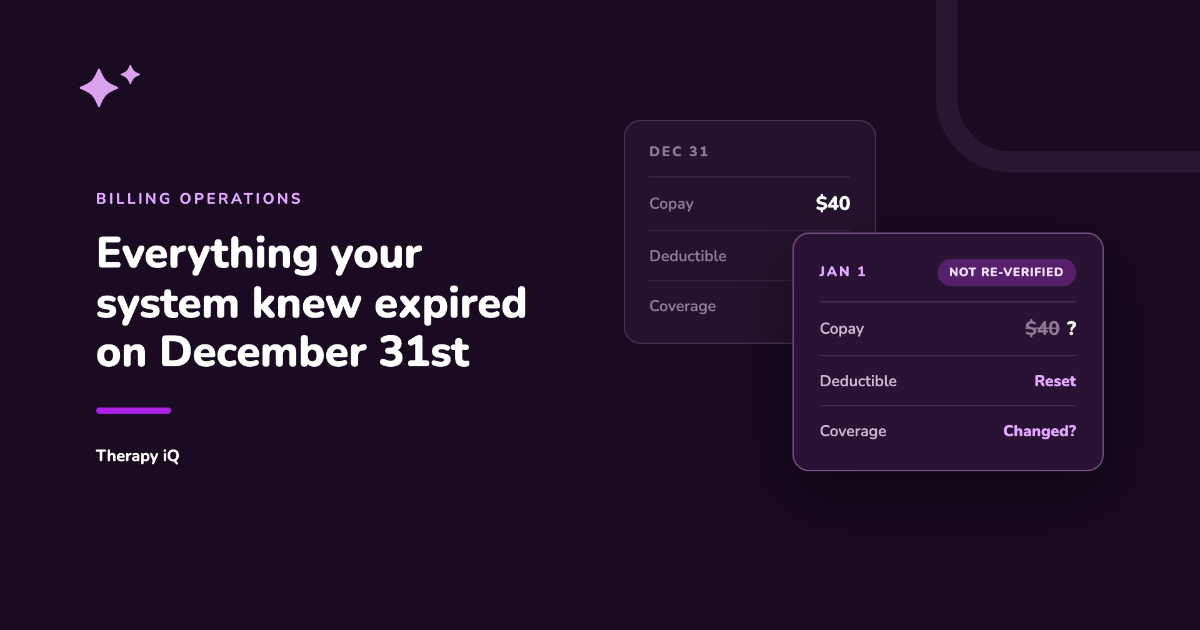
Everything your system knew about your clients expired on the 31st
On January 1, deductibles reset. Clients who switched plans during open enrollment show up with new coverage. People who changed jobs in November show up with insurance they haven't mentioned yet, mostly because nobody asked.
The copay sitting in each client's profile was accurate in December. In January it's a guess.
Traditional EHRs aren't built to notice that. They store what someone typed in last time and present it back with total confidence, like a GPS that still thinks the bridge is open. The checking falls to whoever happens to be at the front desk, which is a person, not a system.
Your front desk becomes the eligibility department
So the front desk re-verifies. Client by client, portal by portal, and when the portal doesn't have the answer, by phone.
This is where the real cost lives. It isn't on any invoice. It's two people on hold with payers instead of answering the phone for the new intake who's calling for the third time. It's a person staying late on a Thursday, and then again the following Thursday, until everyone has been checked.
And it happens every single year. The office has gotten good at it, which is admirable and also a sign that it's been normal for far too long.
The deductible conversation happens at the worst possible moment
Here's a scene most office managers could act out without a script. A client who paid a $40 copay all last year comes in for their first session of January. Their deductible reset at midnight on the 31st. They now owe the full session fee, and they learn this at checkout, with two people waiting behind them.
Or worse, they don't learn it at checkout. They learn it from a statement weeks later, after they've had four more sessions.
Neither version is anyone's fault. But a balance you explain on day one is a conversation. A balance you explain in March is a collections problem, and it tends to arrive right when the client is least happy to hear from you.
"It settles down by February" is when the denials show up
The part of January that people forget about happens in February. Claims that went out with last year's coverage information don't bounce back immediately. They come back denied a few weeks later, usually right around the time everyone agreed things had calmed down.
So the practice pays for January twice. Once in hours at the front desk, and again when a biller has to rework every claim that went out with stale information. That's the aging report quietly getting longer while everyone is looking at the schedule.
What it looks like when the system does the checking
The fix isn't a harder-working front desk. They're already working plenty hard. It's a system that checks benefits on its own instead of waiting for someone to remember.
In Therapy iQ, benefits are checked automatically every 30 days, and the copay, coinsurance, and deductible land directly on the client's profile. The front desk can run a fresh check before any appointment, and a card on file can be charged the right amount the day of the session. January still happens. It just happens to the software first, instead of to the person at the front desk.
I'm not suggesting you switch anything because of one hard month. Plenty of practices get through January on grit and a good office manager every year. But if the first two weeks of January are the part of the year your team quietly dreads, it's worth asking whether that's really just how it is.
So before this January, ask your front desk one question and let them answer honestly: "What part of the first week back do you wish our system just handled?"
Nate is a former Practice Owner and now CEO & Co-Founder of Therapy iQ. He writes about the operational side of running a practice — billing, migrations, and the cost of systems that don't talk to each other.